

All you need to know about Ecology
Definition:
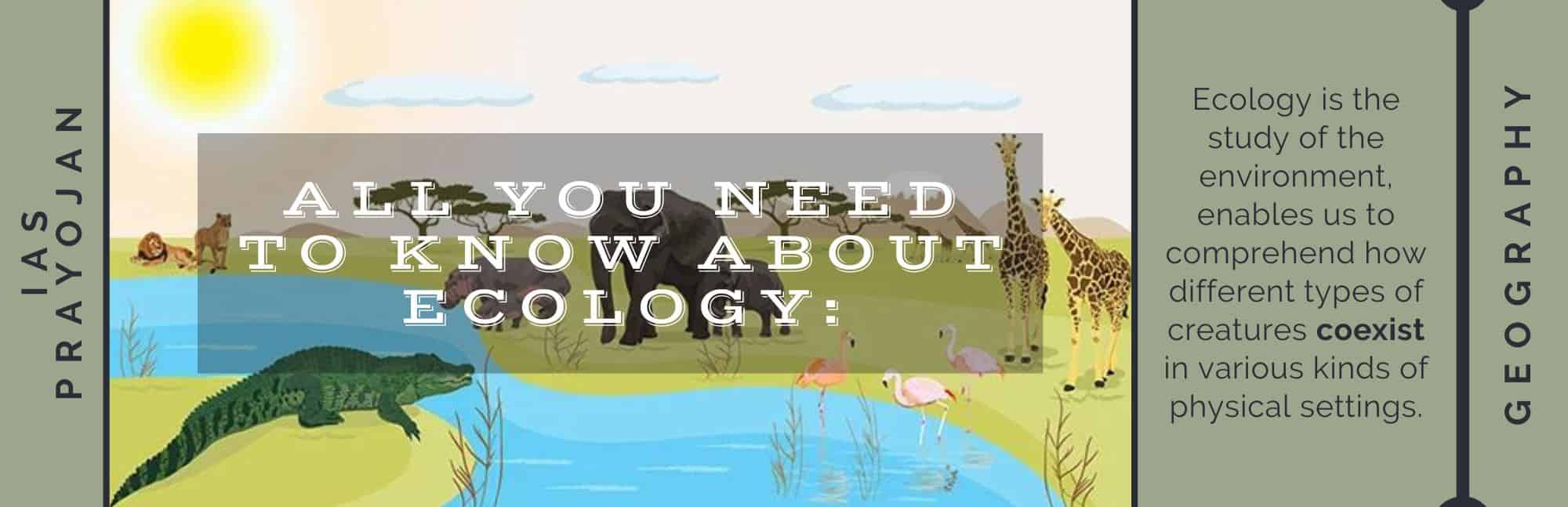
Ecology is the study of the environment, enables us to comprehend how different types of creatures coexist in various kinds of physical settings.
Understanding Ecology:
It is the study of living things and how they relate to their surroundings. An ecologist researches the interactions between organisms and their environments. In order to learn about the natural world, ecologists must study multiple aspects of life ranging from the moss that grows on rocks to the wolf population in the United States' Yellowstone National Park. In order to research the environment, scientists ask questions, such as:
• How do organisms interact with the living and nonliving forces around them?
• What are the necessities for creatures to live and flourish in their existing environments?
Ecologists must research and observe all types of life and their ecosystems around the world in order to determine the answers to these questions.
Ecologists investigate not only how ecosystems work, but also what happens when they don't work as they should. Numerous factors, such as diseases spread by local organisms, temperature rises, and increased human activity, can cause changes in ecosystems. Understanding these changes can help ecologists foresee upcoming ecological problems and educate other scientists and policymakers on the issues affecting their local ecosystems.
In the 1960s, when environmental challenges were becoming more widely known, ecology first started to acquire prominence. Although the natural world has been studied by scientists for ages, modern ecology has only been since the 19th century. Around this time, scientists from both Europe and America started looking into how plants worked and what impact they had on their surroundings. The study of how animals interact with plants, other creatures, and the ecosystems in which they inhabit eventually resulted from this. Modern ecologists continue to disseminate knowledge about the world's ecosystems by building on the data gathered by their forebears. The data they compile still has an impact on the planet's future. All around the world, human activity has a significant impact on how healthy ecosystems are.
A species' food source may become contaminated by pollution from industrial or fossil fuels, which might disrupt the entire food chain. It is possible for local life forms to suffer unanticipated and detrimental effects when a new species is introduced from another part of the planet into an unfamiliar environment. Invasive species are the name given to these kinds of organisms.
Any type of living organism introduced by humans to a new region of the globe where they lack natural predators is considered an invasive species. Because of the spread of disease or overhunting, the addition or eradication of one species from an ecosystem can have a cascading effect on many others.
Ecology Categories/Types:
Ecology is the study of the interactions that organisms have with one another and with their environment. For survival, every organism is dependent on both living and nonliving things. The scientific field of ecology studies the interactions between organisms and their surroundings. Ecologists are researchers who focus on these connections.
There are numerous approaches to studying ecology. Landscape ecology, population ecology, and behavioral ecology are a few examples.

1. Landscape Ecology:
Large-scale spatial distribution, trends, and behaviors are the focus of landscape ecology. Landscape ecologists might research how development affects a specific native grass species in a particular region. For instance, one type of grass might be chemically resistant, indicating that the area would be perfect for agricultural development.
2. Population Ecology:
Population ecology investigates the rise and fall in the number of a species. A population ecologist might contrast a species' population that has access to a new food source with a population that doesn't. The species' population may rise due to the new food source or fall if it is contaminated.
3. Behavioral Ecology:
The field of behavioral ecology investigates how organisms change with their environments and evolve. Behavioral ecologists frequently investigate mating behaviors, or the traits that male and female animals favor when attempting to procreate.
For instance, behavioral ecologists look at the songs or plumage of birds in relation to their mating habits. When ecologists research a specific animal, they look at the animal's food sources, reproductive habits, potential predators, and environmental characteristics.
Additionally, they research the animal's habitat, including its movement patterns, shelter needs, population dynamics, and interactions with the local flora and fauna.
Quick Fact
Deep Ecology
Deep ecology is a recent field of research. According to deep ecology, people should work with their environment rather than against it. Deep ecology does not follow the scientific method, which entails expressing a question, formulating a hypothesis, and then testing that theory through observation and investigation. Compared to other ecologies, deep ecology has more in common with philosophy and political science.