

Interesting Fact About Gray Wolf
Introduction:
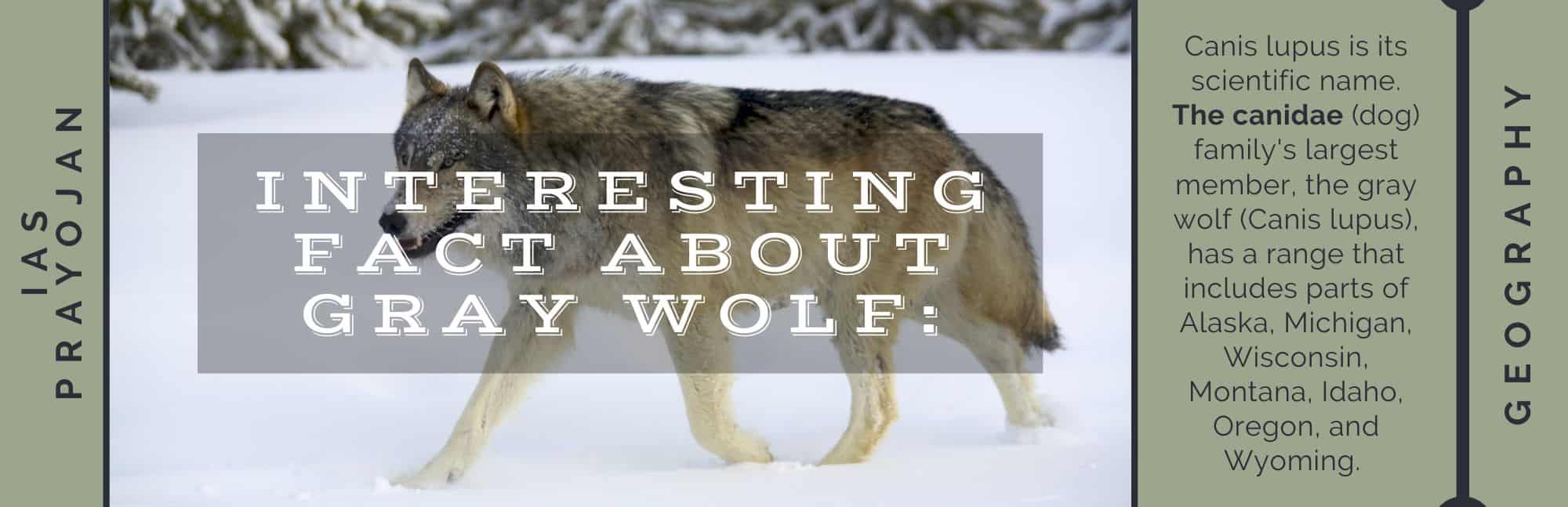
Canis lupus is its scientific name. The canidae (dog) family's largest member, the gray wolf (Canis lupus), has a range that includes parts of Alaska, Michigan, Wisconsin, Montana, Idaho, Oregon, and Wyoming. Domestic dogs, coyotes, and wild dogs like dingoes are all related to gray wolves. According to researchers, the majority of wolf subspecies descended from the gray wolf. According to classification, the gray wolf belongs to the order Carnivora, family Canidae, and subfamily Caninae in the kingdom Animalia.
Fast Facts: Gray Wolves
• Scientific Name: Canis lupus
• Common Name(s): Gray wolf, timber wolf, wolf
• Basic Animal Group: Mammal
• Size: 36 to 63 inches; tail: 13 to 20 inches
• Weight: 40–175 pounds
• Lifespan: 8–13 years
• Diet: Carnivore
• Habitat: Alaska, northern Michigan, northern Wisconsin, western Montana, northern Idaho, northeast Oregon, and the Yellowstone area of Wyoming
• Population: 17,000 in the United States
• Conservation Status: Least Concern
Description:
With their pointed ears and long bushy tails that have black tips, gray wolves resemble giant German shepherd dogs in appearance. White, grey, brown, and black are all possible coat colors for wolves, though most have a combination of hues with tan facial markings and undersides. Male wolves are typically larger than female wolves, while northern wolves are frequently larger than southern wolves.
Location And Habitat:
• In the past, gray wolves could be found in great numbers all over the Northern Hemisphere, including in Europe, Asia, and North America. Gray wolves have lived in practically every sort of climate found north of the equator at one point or another, from deserts to tundra, yet they were hunted to almost complete extinction everywhere they were found.
• Wolves are a keystone species in the habitats they live in. Despite being scarce, they have a significant impact on their surroundings. Gray wolves exert control over the populations and behaviors of large herbivores like deer, which are currently overabundant in many areas. As a result, even the vegetation is eventually impacted thus, Wolves play a significant part in rewilding projects.
• One of the animal species that survived the previous ice age is the gray wolf, a very adaptive animal. The physical qualities of the gray wolf allowed it to quickly adapt to the severe ice age circumstances, and its cunning and adaption let it survive in the shifting environment.
Diet:
• Large ungulates, or mammals with hooves, such as deer, elk, moose, and caribou, are often the prey of grey wolves. Gray wolves also consume fish, birds, lizards, snakes, and fruit in addition to smaller mammals like hares and beavers. As scavengers, wolves will consume the flesh of animals killed by other predators, by motor vehicle and so on.
• Wolves eat their fill when they locate enough of food or have a successful hunt. In a single feeding, a lone wolf may eat up to 20 pounds of meat.
Behavior:

• Sociality is a feature of gray wolves. They frequently travel great distances—up to 12 miles or more—in a single day and typically live and hunt in packs of six to ten individuals. A wolf pack will typically hunt in groups, working together to pursue and take down huge animals.
• There is a clear hierarchy within wolf packs, with a dominant male and female at the top. The only two wolves in the pack that typically reproduce are the alpha male and female. By bringing them food, teaching them, and protecting them from danger, all of the older wolves in the pack contribute to taking care of the pups.
• Gray wolves use a variety of barks, whines, growls, and howls as part of their elaborate communication system. Gray wolves use their eponymous and renowned howl as one of their communication methods. While wolves in the same pack may howl together to establish their territory and advertise it to other wolf packs, a lone wolf may howl to draw the attention of his pack. In addition to being defensive, howling can also be a response to the howls of other wolves nearby.
Procreation And Offspring:
• The majority of wolves procreate only once a year, between January and March (or earlier in the south). About 63 days of the gestation period, wolves give birth to four to six pups.
• Wolf mothers give birth in a den, which is often a burrow or cave, where they can watch and care over the helpless, blind, and very underweight pups. Throughout their first several months of life, she would transfer the pups multiple times. Until the pups are old enough to handle meat on their own, wolves regurgitate their food to feed their offspring.
• Until they are roughly three years old, young wolves remain with their mother's pack. They then choose whether to remain with their group or do it alone one their own.
Protection Level:
• The conservation status of grey wolves is ‘’Least Concern’’, indicating that there is a sizable and steady population. In 1995, the reintroduction of wolves to Yellowstone National Park and some areas of Idaho was successful. They have been resettling naturally in Washington and Oregon, expanding their former range. 2011 saw the arrival of a lone male wolf in California.
• Now there is a permanent pack there. Gray wolves are currently thriving in Minnesota, Michigan, and even Wisconsin in the Great Lakes region. People's continued fear of wolves, because of the fact that many farmers and ranchers view grey wolves as a threat to their livestock, and hunters' demand for the government to declare open season on grey wolves in order to stop them from preying on game animals like deer, moose, and elk.
• Most grey wolves in the United States had been eliminated by the middle of the 1930s. Today, only Canada and portions of Alaska, Idaho, Michigan, Minnesota, Montana, Oregon, Utah, Washington, Wisconsin, and Wyoming remain in the gray wolf's original habitat in North America. Arizona and New Mexico are home to the Mexican wolf, a subspecies of the gray wolf.
Tussle Between Humans And Gray Wolves:
• Humans and wolves have a long history of conflict. Even though wolves rarely attack people, both people and wolves are apex predators in the food chain. As a result of habitat loss and wolves' increased propensity to attack livestock, they frequently come into conflict.
• Over the years, wolves have developed a bad reputation because to popular culture. It is particularly challenging to show wolves as a species that needs to be conserved because fairy tales like "Little Red Riding Hood" portray them as dangerous predators.
• Wolves are viewed as both icons of the wilderness and symbols of strength, despite certain bad interactions. Keeping wolves or wolf/dog hybrids as pets, a practice that is rarely successful for the animal or its owner, may be due in part to this.