

Overview of Yellowstone National Park's Geography
Topography:
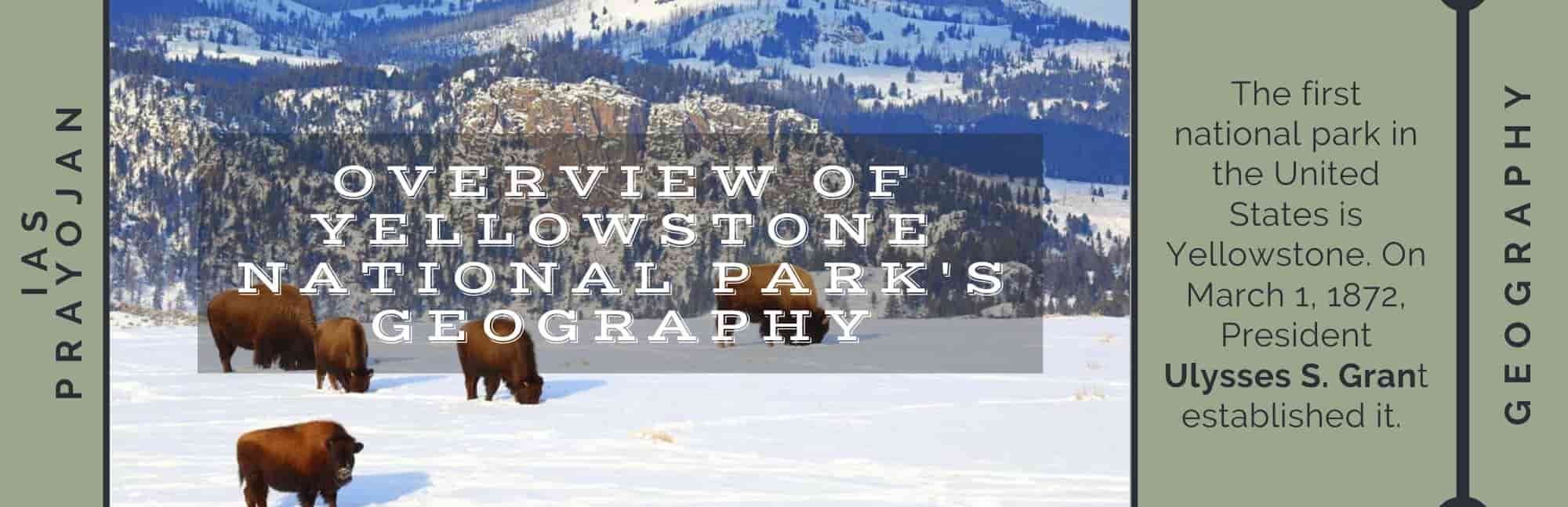
The first national park in the United States is Yellowstone. On March 1, 1872, President Ulysses S. Grant established it. Yellowstone is primarily in Wyoming, but it also touches Montana and a small portion of Idaho. It is made up of numerous geothermal features like geysers, as well as mountains, lakes, canyons, and rivers, and spans an area of 3,472 square miles (8,987 sq. km). The Yellowstone region is home to a wide variety of vegetation and animals.
Background:
Around 11,000 years ago, Indigenous tribes started to hunt and fish in the area, beginning human habitation in Yellowstone. It is thought that these prehistoric people belonged to the Clovis civilization and made their Clovis points and other hunting weapons and artefacts from the obsidian found in the area.
Lewis and Clark were some of the first explorers to set foot in the Yellowstone region in 1805. They came into contact with a number of Native American tribes while they were there, including the Nez Perce, Crow, and Shoshone. A geothermal area in the park was discovered by John Colter, a member of the Lewis and Clark expedition who deserted the company in 1806, to join fur trappers.
Early Yellowstone investigations began in 1859 when Captain William Reynolds, a U.S. Army surveyor, started venturing into the northern Rocky Mountains. Due to the start of the Civil War, exploration of the Yellowstone region was subsequently put on hold and did not formally resume until the 1860s.
The Cook-Folsom-Peterson Expedition made one of the first thorough explorations of Yellowstone in 1869. The Washburn-Langford-Doane Expedition shortly afterward in 1870 spent a month examining the area, collecting various plants and animals, and naming special locations. After that mission, Montanan Cornelius Hedges, a writer and attorney who had participated in the Washburn expedition, proposed designating the area as a national park.
Even though there was a lot of activity to protect Yellowstone in the early 1870s, the Hayden Geological Survey of 1871, completed in 1871 by geologist Ferdinand Hayden, marks the beginning of serious attempts to establish Yellowstone as a national park. Hayden obtained a comprehensive report on Yellowstone during the investigation.
In order to prevent the area from being purchased by a private landowner and taken away from the general public, it was this report that finally persuaded the US Congress to designate the area as a national park. President Ulysses S. Grant signed the Act of Dedication on March 1st, 1872, thereby officially establishing Yellowstone National Park.
Millions of people have visited Yellowstone since it opened. Within the park's boundaries there have been built roads, a number of lodges, including the Old Faithful Inn, and visitor centers, including the Heritage and Research Center. Other well-liked leisure pursuits in Yellowstone include snowshoeing, mountaineering, fishing, hiking, and camping.
Climate And Geography Of Yellowstone:

96% of Yellowstone's acreage is located in Wyoming, with the remaining 3% and 1% being in Montana and Idaho, respectively. The greatest body of water in Yellowstone is Yellowstone Lake, which covers 87,040 acres and is up to 400 feet (120 m) deep. Rivers and lakes account roughly 5% of the park's total land area. With a height of 7,733 feet (2,357 m), Yellowstone Lake is the highest lake in North America.
The remaining area of the park is largely covered in forest, with some grassland. Much of Yellowstone is likewise dominated by mountains and narrow canyons. The climate of Yellowstone is influenced by the park's varying altitudes. Although summers in Yellowstone often average 70–80°F (21-27°C) with afternoon thunderstorms, they are cooler at lower elevations. Winters in Yellowstone are typically extremely cold, with highs only around 0-20°F (-20- -5°C). In the park, it frequently snows in the winter.
Yellowstone Geology:
As a result of its location on the North American plate, which has been gently moving across a mantle hotspot for millions of years via plate tectonics, Yellowstone has a distinctive geology that first gained it fame. This hot spot and subsequent massive volcanic eruptions resulted in the formation of the Yellowstone Caldera, the biggest volcanic system in North America.
In Yellowstone, geysers and hot springs are other frequent geological features that have developed as a result of the hotspot and geological instability. Although Old Faithful is the park's most well-known geyser, there are 300 others.
Yellowstone also frequently suffers minor earthquakes, the majority of which are not felt by people, in addition to these geysers. However, the park has been hit by large earthquakes with magnitudes of 6.0 or higher. For instance, a magnitude 7.5 earthquake that occurred just outside the park's boundaries in 1959 resulted in landslides, geyser eruptions, significant property damage, and the deaths of 28 people.
Wildlife Of Yellowstone, Flora And Fauna:
Yellowstone is home to a wide variety of plants and animals in addition to its distinctive geology and geography. For instance, the Yellowstone region is home to 1,700 different types of trees and plants. It is also home to a wide variety of animal species, including several mega faunas like grizzly bears and bison.
The grey wolf, black bears, elk, moose, deer, bighorn sheep, and mountain lions are just a few of the 60 different species of animals that may be found in Yellowstone. Within the limits of Yellowstone, there are also 18 species of fish and 311 species of birds.