

The Influence Of Native Americans On The Founding Of The Us
Background:
With regard to the rise of United States and contemporary democracy, High school history textbooks often place a strong emphasis on the impact that ancient Rome had on the founding fathers' idea about the future shape that the new nation would take. Even graduate-level political science departments lean in this direction, yet there is a lot of research on the inspiration the founding fathers received from Native American political ideologies.
What the founders absorbed from Indians and what they purposefully rejected in the creation of the Articles of Confederation and later the Constitution can be determined from an examination of the documentation proving those influences, which is based on the work of Robert W. Venables and others.
Prior To The Constitution:
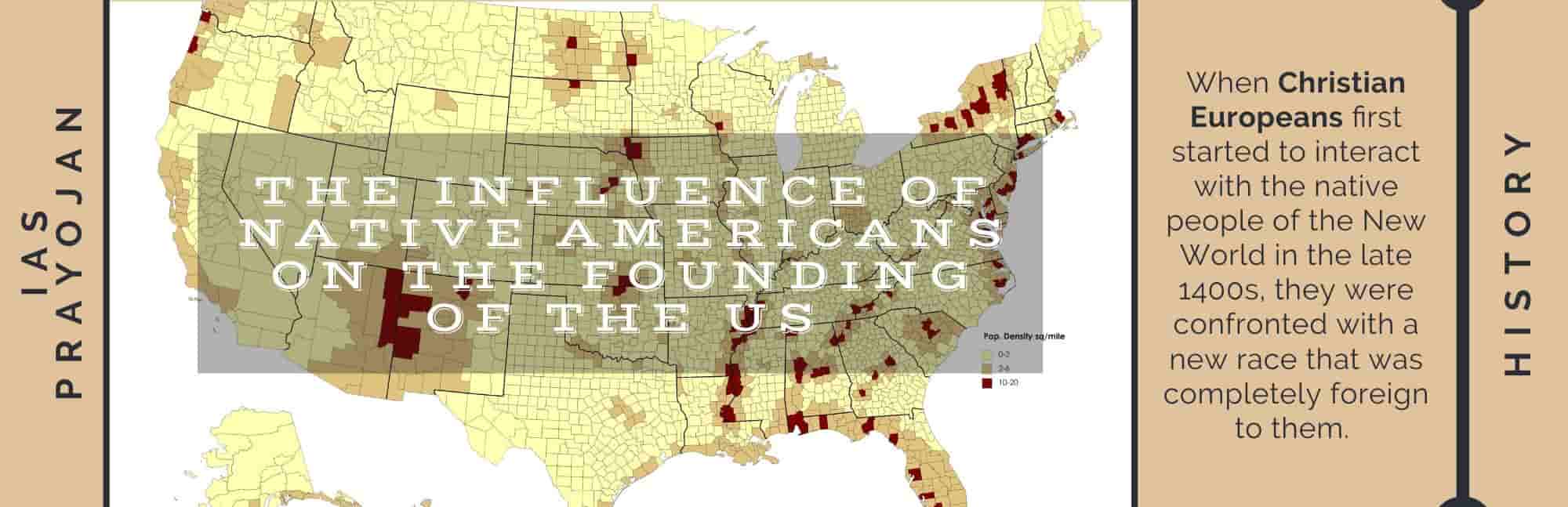
When Christian Europeans first started to interact with the native people of the New World in the late 1400s, they were confronted with a new race that was completely foreign to them. The Europeans' perceptions toward the locals would be based on analogies to themselves, even if by the 1600s the natives had caught their imaginations and knowledge of the Indians was ubiquitous in Europe.
Due to these ethnocentric viewpoints, stories about Indians would represent either the "noble savage" or the "brutal savage," yet both descriptions would be savage. Examples of these imagery can be found in the writings of authors like Shakespeare (especially "The Tempest"), Michel de Montaigne, John Locke, Rousseau, and many more across European and pre-revolutionary American culture.
Perspectives Of Benjamin Franklin On Native Americans:

Benjamin Franklin was the Founding Father who was by far the most impacted by Native Americans and had bridged the gap between European notions (and misconceptions) and real life in the colonies during the years of the Continental Congress and the drafting of the Articles of Confederation.
Remarks Concerning the Savages of North America, a classic piece of literature and history, was written by Benjamin Franklin, who was born in 1706 and worked as a newspaper journalist. Franklin spent many years observing and interacting with Native Americans, primarily the Iroquois but also the Delawares and Susquehannas.
The essay includes a less-than-flattering depiction of Iroquois perceptions of the colonists' way of life and educational system, but it also serves as a critique on Iroquois cultural norms. Franklin expressed his admiration for the Iroquois governmental structure in the following statement:
"For all their governance is by the Council or advice of the sages, there is no force, there are no jails, and there are no officers to compel allegiance, or inflict punishment. As a result, they frequently study oratory, as he brilliantly put it when he described consensus government and the power of the best speaker.
He went into more detail about the manners displayed by Indians in Council sessions and contrasted them with the boisterous atmosphere of the British House of Commons.
Benjamin Franklin would go into greater detail about the superiority of Indian food in future articles, praising corn in particular as "one of the most pleasing and healthful grains of the world." He would even make the case that American forces should emulate the British use of Indian tactics during the French and Indian War.
Influences On The Constitution And The Articles Of Confederation:
The colonists drew on the ideas of European philosophers like Jean-Jacques Rousseau, Montesquieu, and John Locke when creating the ideal form of government. Particularly Locke wrote on the "state of complete freedom" enjoyed by Indians and made theoretic arguments for why the people, not a monarch, should have authority.
However, it was the colonists' firsthand accounts of the Iroquois Confederacy's political procedures that persuaded them of how the exercise of popular power in fact led to an effective democracy. According to Venables, Native influences are directly responsible for the idea of the quest of life and liberty.
The Indian philosophy of communal landholding was diametrically opposed to the European idea of individual private property, and it was the protection of private property that would be the thrust of the Constitution. However, this was where Europeans and Indian political theory diverged (until the creation of the Bill of Rights, which would return the focus to the protection of liberty).
However, Venables contends that overall, to the cost of the Indian nations, the Articles of Confederation would more accurately represent American Indian political ideology than the Constitution. In contrast to the loose confederation of the cooperative but independent Iroquois nations, which was much more intimately related to the union created by the Articles, the Constitution would establish a central administration in which authority would be consolidated.
The Founding Fathers valued imperialist expansion of the United States more than the liberty of the "savages," whom they believed would ultimately suffer the same fate as their own tribal forebears in Europe due to such power consolidation. Ironically, despite the colonists' teachings from the Iroquois, the Constitution would adhere to the precise model of British centralization that they had opposed.